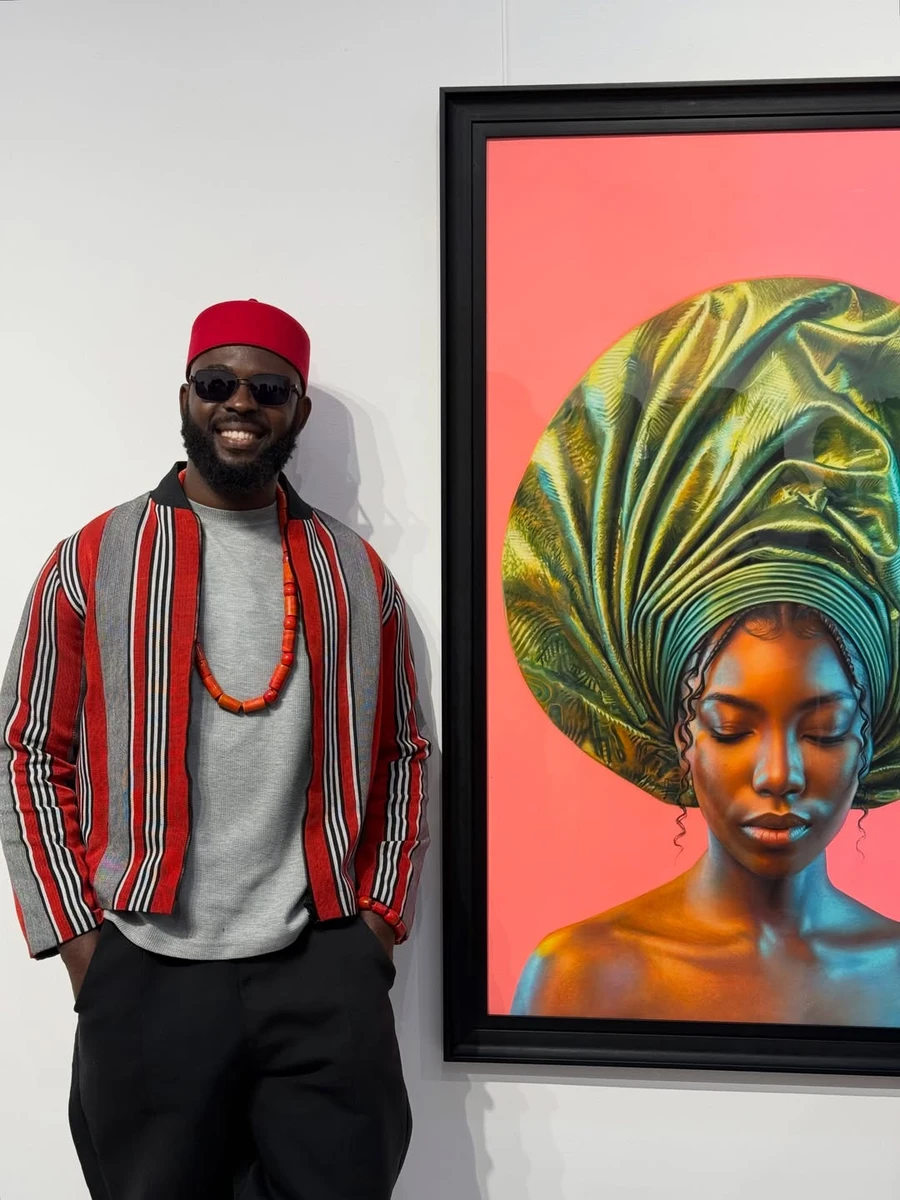

A gele can be folded, twisted, and arranged into remarkable shapes, sometimes rising several inches above the wearer's head. In Arinze Stanley's drawings, these familiar Nigerian headwraps become elaborate sculptural forms, with every fold, crease, and overlapping layer carefully rendered on paper. His Gele series is particularly fascinating for the attention it gives to something many of us have grown up seeing at weddings, celebrations, and family gatherings. The portraits bring us close enough to appreciate the construction of the fabric, the texture of the skin beneath it, and the expressions of the women wearing these magnificent arrangements. Working primarily with charcoal, graphite, and coloured pencils, the Lagos-based artist has developed an extraordinary ability to make drawings feel almost photographic, while giving his subjects a presence that goes beyond technical accuracy.
Arinze began drawing at the age of six and developed much of his technique independently. His work is associated with hyperrealism, a demanding approach that requires careful observation and a considerable understanding of light, texture, and form. Looking at pieces such as Gele VI, Gele X, and Gele XVIII, we can appreciate the patience involved in building these images. The fabric appears soft in one section and tightly structured in another, while the subtle changes in tone help distinguish each overlapping fold. His earlier drawings relied heavily on monochromatic charcoal and graphite, but he has gradually expanded into colour, introducing new possibilities for representing fabric, skin, and the visual richness of his subjects. The results are especially interesting when the colourful headwraps occupy large portions of the composition, giving the portraits an almost architectural quality.
Although his technical ability attracts considerable attention, Arinze's practice is concerned with more than producing convincing representations of people. His work explores power, systemic exploitation, and the experiences of Black people, using portraiture as a way to examine the realities surrounding him. In his Machine Man series, for instance, he continues this interest through detailed figurative drawings that invite viewers to consider the people and circumstances being represented. Works such as The Machine Man 14 and The Machine Man 15 have appeared in international exhibitions, including Simulacres at Magasins Généraux in Pantin, France, and Five and Under at Arcadia Contemporary in New York. These pieces expand our understanding of his practice, revealing an artist who uses the precision of his drawing to explore difficult social questions alongside more intimate examinations of identity and cultural expression.
His recent Gele exhibition at Alexis Galleries in Lagos, presented in collaboration with sculptor Dotun Popoola, offered another opportunity to experience his work beyond the screen. The exhibition brought together different artistic approaches to the gele, with Arinze's drawings engaging with Dotun's sculptural practice. The pairing is particularly fitting given how much sculptural presence the headwraps already possess in Arinze's compositions. His work has also been presented at ART X Lagos and in galleries across the United States, including Arcadia Contemporary and Corey Helford Gallery. Alongside exhibiting internationally, he continues to work from The Pond Studio in Lagos, where he leads The Pond Collective, an initiative that supports artistic exchange through workshops and a media series. We appreciate this part of his practice because it creates opportunities for other artists to learn, connect, and develop their own approaches to making art.
What we find most compelling about Arinze's work is the relationship between its extraordinary detail and the subjects he chooses to represent. The technical achievement is immediately apparent, but spending time with the drawings reveals a wider interest in dignity, identity, cultural memory, and the experiences of the people around him. His Gele series takes a familiar expression of Nigerian fashion and presents it with a sense of importance that encourages us to consider its beauty and cultural significance more closely. The expansion into colour, his continuing exploration of social themes, and his involvement with other artists suggest a practice that is still growing in interesting directions. Arinze reminds us that drawing can be both a demonstration of remarkable skill and a means of asking meaningful questions about the world we inhabit.